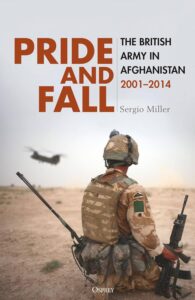
In his introduction to this sweeping and detailed history Britain’s war in Afghanistan the author describes how “Britain’s overstretched and ill equipped army would find itself committed to a conflict that would test it to the limits.” His history of the war describes the origins of Britain’s involvement, how they ended up in Helmand province and how successive operations attempted in differing ways to wage a successful war against the complicated assortment of tribal opponents, whilst at the same time endeavouring to develop and improve the lives of the Aghan people.
After explaining the reasoning behind Britian’s entry into the war as a domino effect, that is the argument that jihadist dominos would fall on streets in Britain unless action was taken, Millar launches into an extremely detailed and chronological description of the war. He details the number of and defence secretaries involved from 2001 to 2024 and the variety of strategies and opinions they encompassed which did not help produced a coherent plan for the conflict.
On the ground Millar takes us through the various Herrick operations and the differing options and choices made by each commander and the varying fortunes of the ISAF (International Security Assistance Force). The different tactics of, for example, the Parachute Regiment and the Royal Marines are examined in detail and the different approaches, such as “mowing the lawn” and “clear, hold, build” are examined in terns of success and failure. The failure of the British to fully understand the nature of tribal opposition to them, and the fact that their actions exacerbated that opposition was another factor in the failure.
In addition to the bigger picture, the author gives much attention to the experiences and fates of the soldiers and marines in the ground in the various Herrick operations, with many compelling stories of courage and determination and battling with the constant problems of IEDs. Despite the eventual “fall” – the withdrawal and the fact that the Taliban were not defeated – Millar has examples of what went well “the pride”, the improvements in intelligence gathering and communication and the development of Casevac and medical services.
However, when Britain withdrew British casualties amounted to 450 killed and 2,000 wounded. There was no long-term benefit to the people of Afghanistan. Millar has rightly pointed out the mistakes made by politicians and military leaders in terms of mistaken direction and inadequate resources.
This long and detailed book is not always an easy read as it is hard hitting and pulls no punches, but it will become one of the most authoritative accounts of Britain’s involvement in Afghanistan. The book ends however on a positive note. Reflecting on the courage shown by the British forces in the face of the difficulties of war in Helmand province, underfunding and defence cuts, Millar considers that “If the war was a swansong for the British army, then the band played lustily. Tommy Atkins marched away with a flourish of courage.”