Some thoughts on polar exploration and the Top Gear special
Should we bemoan the loss of heroic figures in Arctic exploration?
It is tempting in an age of increased technological and navigational skills used to travel on the Polar Ocean to bemoan the loss of the heroic figures of Arctic exploration. These men endured great hardships and showed enormous courage in their attempts to reach the North Pole and conquer the North West Passage.
One does not have to look far however to find difficult and sometimes dangerous exploits taking place in the Arctic Ocean today as the emphasis changes from exploration to research into climate changes and the shrinking of the polar ice areas. On April 12th this year three Russian cosmonauts jumped from a Ilyushin -76 aircraft from the stratosphere at 10.000 above the icy wastes of the North Pole. The stratosphere at the North Pole begins at 8000 ft, so the men had to free fall for two minutes until the air was dense enough to support a parachute. They endured temperatures of between -50 and -70 degrees centigrade and suffered frostbite as they descended. They landed safely at Russia’s Barneo Polar base, a temporarily inhabited camp near the North Pole. The jump had important research targets including the testing of a new prototype communications system.
A watershed moment
In the last ten years exploration and scientific research has become increasingly dependent on modern technical and highly engineered transport. The MOSAIC expedition (Multidisciplinary drifting observatory for the study of Arctic) was made possible using the ice breaker RV Polarstern and for the first-time helicopters were employed in Arctic research.
It can be argued that a watershed moment in the modern development of Polar research and exploration came from the British Television programme Top Gear, in its Polar Special of 2007, in which their presenters took part in a race to the North Magnetic Pole to prove that a suitably adapted car could travel successfully in extreme Arctic conditions.
Top Gear enters the polar scene
One team, presenters Jeremy Clarkson and James May, travelled in a specially adapted car, a Toyota Helix, while the other team consisting of Richard Hammond and explorer Matty McNair travelled by dog team. It was quickly obvious that the winning team, would be the car team and May and Clarkson were shown drinking gin and tonic on the way, which caused some consternation in the British media. The presenters had realised that Arctic exploration was in fact no joke and were flown back to base after their admittedly arduous but successful ordeal.
This mainly light-hearted and comedic presentation, populated by television celebrities was however in some ways in the tradition of early attempts to reach the North Pole. In separate expeditions Americans Robert Peary and Frederick Cook in 1907, announced within weeks of each other that they had reached the North Pole. Both men were feted by the public and given honours and awards, becoming major celebrities, but both their attempts were later discredited.
The "Heroic Age"
These attempts at the beginning of the 20th Century were part of the “Heroic Age” of polar exploration, before the development of navigational aids and improvements in technical equipment and clothing. The early explorers of both the Arctic and the Antarctic became media giants, who if they returned to tell the tale did lecture tours, make public appearances and wrote popular books. In the 21st Century they would have been popular on Tik Tok and Instagram. If they did not return, like Captain Robert Scott near the South Pole and Captain John Franklin in the Northwest Passage, they have an even larger profile in polar exploration.
The North Pole was reached by several means in the 20th Century. Admiral Richard Byrd claimed to have flown over the North Pole in 1926, but once again in the years following this was controversially challenged. Also, in 1926 Roald Amundsen flew the Airship Norge over the Pole on 12th May. As the expedition was financed by an American, Lincoln Elsworth, both Norwegian and American flags were dropped over the pole. The USS Nautilus sailed under the pole in 1968, and it was reached by a party on snowmobiles led by Ralph Plaisted in 1968. it was not until 6th April 1969 that the British explorer Wally Herbert made the first successful non-motorized expedition to that North Pole by using dog sleds. Perhaps the ultimate accolade in attempts at the North Pole should go to Borge Ouland who skied unsupported to his goal in 1994.
The fascination of our struggles with nature
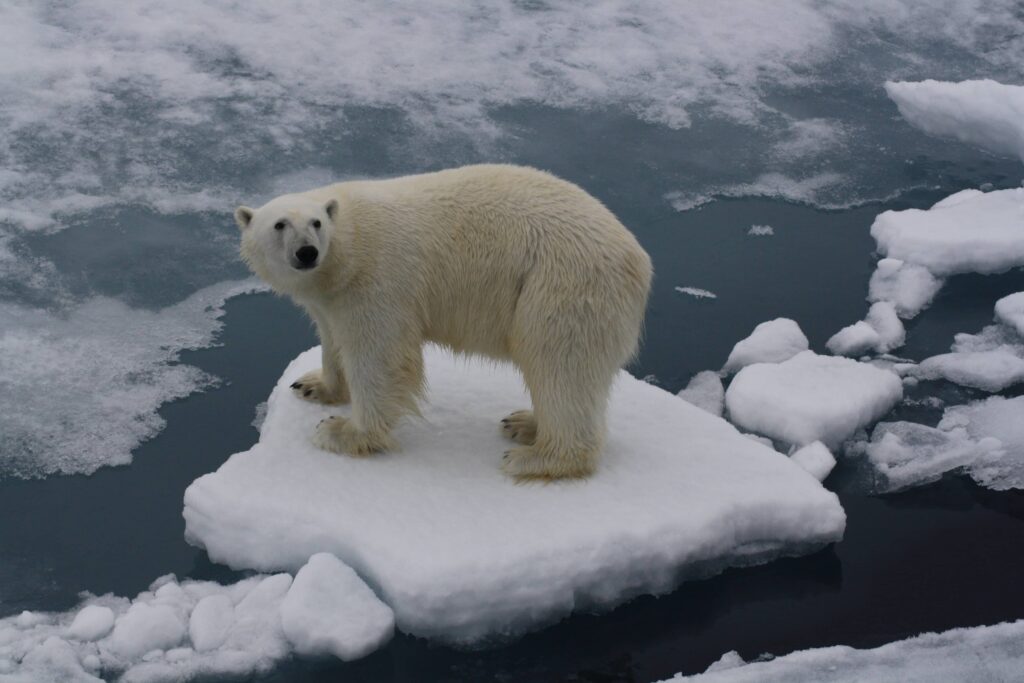
The Top Gear “Polar Special” tuned into the perennial popularity of exploration with the public, although this has perhaps declined in the years since the “big targets” such as the poles and Mt Everest have been conquered, the fascination with man and women’s struggle with nature has continued However, the sad fact is that an ice-covered North Pole will not be there for many years longer. The definition of an ice-free summer in the Arctic Ocean is when it has less than one million square miles of sea ice. Climate models are predicting different dates for when this might happen. The NCEI, National Centre for Environmental Information cited 12 models with 12 models predicting a date of 2054, but variations occurring as soon as 2023, which has already been proven wrong, to as late as 2100. As a result of global warming the overall area of sea ice has been rapidly reducing over the last few decades. The National Oceanic and Atmospheric Administration, NOAA, produces an annual Arctic Report Card and in 1923 this stated that in September 2023 the sea ice minimum was lower than 2021 or 2022 and sixth lowest since 1979.
A watershed moment
Like the heroic explorers, the Top Gear team used the latest technological and navigational advances, and with an excellent support team were rightly praised for the real achievement of reaching the Magnetic North Pole with their Toyota Helix.
As I argued in my article for The European the expedition marked watershed in the continuing story of mankind’s ability to conquer the Polar regions. Despite its popular and comedic vein, the Polar Special showed how advanced technical engineering combined with competitive spirit and determination can challenge the boundaries of what is possible in motorised transportation in Polar regions. The expedition had the clear aim of proving that a wheeled vehicle could be used for transport and this it achieved.
© Dr Linda Parker 2024
About The Author - Dr Linda Parker
After teaching History for twenty or so years Linda decided to change course and enjoyed studied for her PhD at Birmingham University. She is now an independent scholar and author. Her main writing focus is on army chaplaincy in both world wars, and her main historical interests lie in 20th century military, social and religious history but she also has a keen interest in the history of polar exploration.
Linda is a co-founder of the British Modern Military History Society and is a member of the Royal Historical Society, the Western Front Association, the American Commission for Military History and the Society for Military History. She is a trustee of the Toc H movement and convenor of Toc H Wessex.